

10
Sep
2025
If you’ve ever stood on a site after a close call, you know the quiet that follows. Helmets, permits, posters—all still there. What’s missing is the sentence that could have been said five minutes earlier.
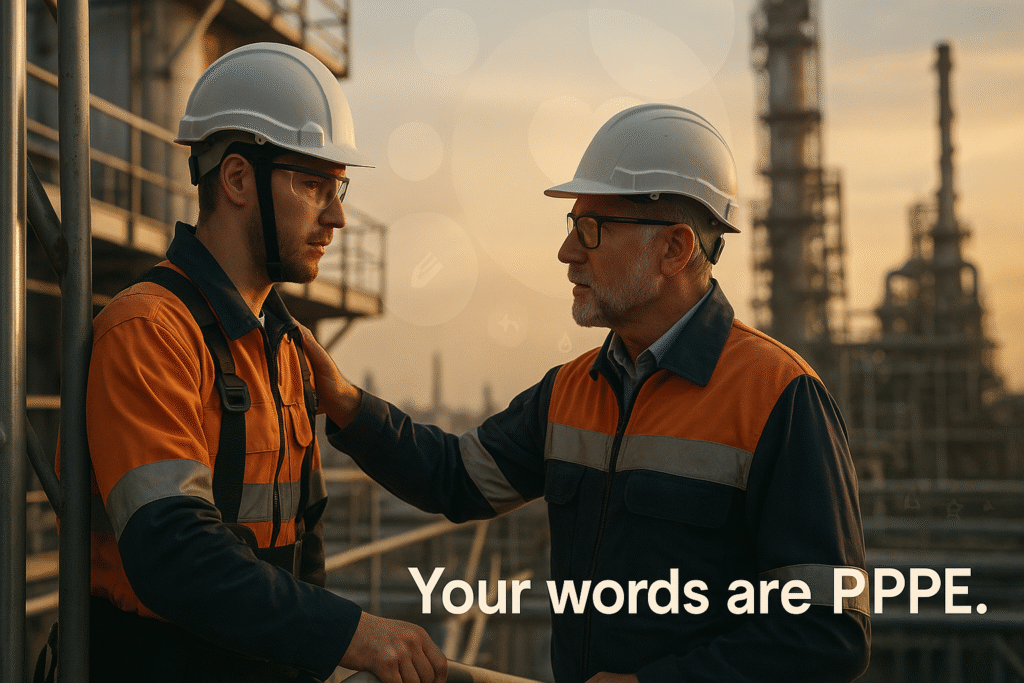
Safety isn’t built by paperwork alone. It’s built by the way we talk to one another—on the stairs, beside the forklift, at the start of a shift. One clear question can prevent a lifetime of regret. One careless message can tip a good worker into a bad moment. Your words are part of the PPE. 🎯
What a “powerful conversation” looks like
It isn’t longer. It’s sharper. It starts with intent: What do I want this person to walk away believing? Not “follow the rule or else,” but “you matter, your future matters, and that’s why this step is non-negotiable.”
Five arcs you can use today
- Connect: “How are you—really? Anything pulling your mind off the job?”
- Explore: “What felt off there? What did you assume?”
- Affirm: “Stopping the task showed leadership. That choice protects the crew.”
- Anchor purpose: “Who are you doing this for?” Link the why to the step.
- Commit: “What will you do differently next time?” Let them say it out loud.
A simple rhythm for the field (STAR)
Stop and See – Pause. Read the person, not just the procedure.
Think and Talk – Ask open questions; listen more than you speak.
Act and Align – Agree on the safe action and why it matters to them.
Review and Reinforce – Name what went right; lock in the lesson.
What to say after a near miss
Skip the lecture. Try this three-step After-Action script:
- Reflection: “Walk me through your headspace. What was going on?”
- Resolve: “What is this close call trying to tell us about how we work?”
- Renewal: “One change you’ll own; one I’ll own. When do we check back?”
The quiet killers: fatigue, distraction, overconfidence
Most bad days don’t start with bad people. They start with tired ones, worried ones, or over-sure ones. Ask for early warning signs.
- “How did you sleep?”
- “Any pressure on your mind today?”
- “What step have we started doing by memory instead of mindfulness?”
Supervisors: lead like a shepherd, not a siren
People don’t remember posters; they remember phrases. Show up, ask twice, listen for the pause before the answer. Use toolbox talks as dialogues, not downloads.
Try these:
- “What’s the worst that could happen on today’s task?”
- “What’s one habit we’ve let slide?”
- “What would you tell your apprentice to do here—then do that.”
Families are part of the safety system
Timing matters. A hard message sent before a high-risk job can fracture attention. Make a simple home code: work first, talk later unless it’s urgent. Love is a safety layer. ❤️
Pocket prompts you can keep
Use them in the lift, on the catwalk, or at the bench.
- “What would a safe, confident action look like right now?”
- “If something goes wrong here, what will it most likely be?”
- “What will you repeat next time because it served you well today?”
One-week challenge to change culture
Day 1: Ask three workers, “What’s pulling your focus today?” Log what you hear.
Day 2: During a job brief, add one purpose line: “This step is how you still make it to dinner.”
Day 3: Catch one good intervention; praise it specifically.
Day 4: Choose one recurring shortcut; ask the crew how to fix it. Adopt their best idea.
Day 5: Do a five-minute STAR review with someone who had a tough shift.
Weekend: Text your team one sentence: “Proud of how you looked out for each other this week.”
Repeat next week with new names.
The sentence that saves a life
“Clip on—your daughter needs you home.” That’s not soft. That’s specific. That’s culture, spoken out loud. 🛠️
In the end, the strongest guardrail is the one we build in each other’s minds. Say the words that hold the line, and say them before the siren.